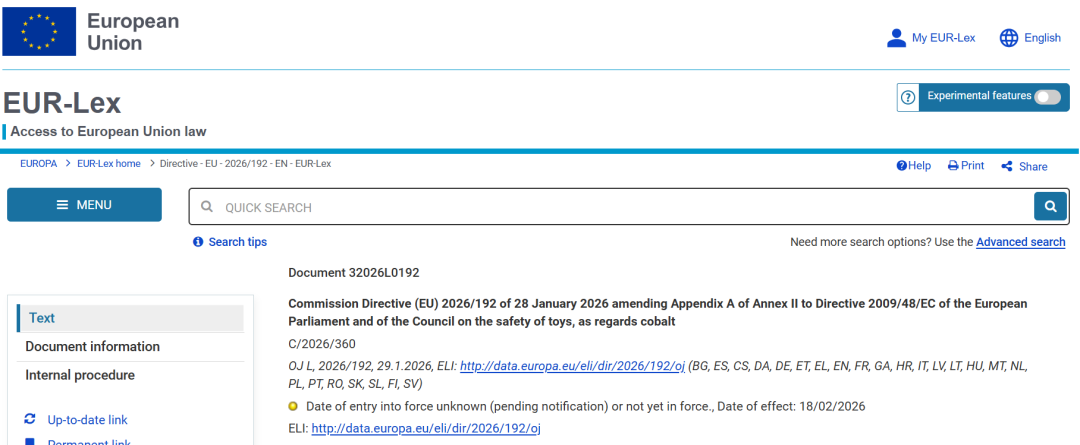
This directive shall come into effect twenty days after its publication in the Official Journal of the European Union.
Each member state shall formulate and publish the laws, regulations, and administrative provisions required for the implementation of this directive on or before July 29, 2026, and immediately notify the Commission of the texts of the above provisions. These provisions shall apply from August 29, 2026.
According to EU law, cobalt and its salts (such as cobalt sulfate and cobalt chloride) are classified as Class 1B carcinogens, Class 2 mutagens, and Class 1B reproductive toxic substances. Although cobalt plays an important role in conductive components, pigments, and batteries, the updated directive recommends limiting its use as cobalt may come into contact with the human body through inhalation, skin contact, and ingestion, especially in children's products.
Scientific evaluations indicate that cobalt is present in toy components such as nickel alloys, model railway tracks, fingertip gyroscopes, and children's cosmetics, usually intentionally added or as an impurity in nickel.
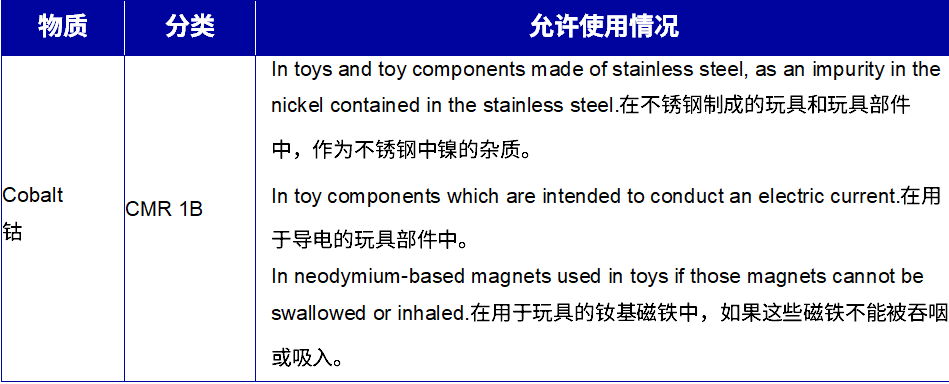
The committee recommends that the use of cobalt in specific toys should only be allowed if it can be proven to be safe for use. These include:
Stainless steel components containing cobalt as a nickel impurity
Electrical conductors in toys (such as model trains)
NdFeB magnets, provided they are too large to swallow or inhale
In contrast, due to unresolved exposure risks and insufficient safety data, cobalt in 3D printing materials, powdered toys, inks, and children's cosmetics will not be allowed to be used.
Manufacturers must also consider that evaluations have found that in several use cases, the analysis of alternatives is incomplete - which is an important drawback for companies that rely on cobalt containing materials. However, suitable alternatives have not been found for the approved applications, so continued use is allowed under strict restrictions.

